Do I need a pumped monitor or a diffusion monitor?
If you test a space before anybody enters it, you need a pump. If you are protecting a person while they work, you need diffusion. Most confined space programs need both.
A diffusion instrument has no pump. Gas reaches the sensors by moving into the instrument on its own, which means it reports the air it is sitting in and nothing else. That makes it the right tool clipped to a collar inside the breathing zone, and the wrong tool for a space nobody has entered yet, because using it there means putting it, and the person holding it, inside.
A pumped instrument draws sample through a probe or a hose, so the atmosphere inside a tank, a vault or a manhole can be characterized from outside it. That is what 29 CFR 1910.146(d)(5)(i) requires when it says the space has to be tested before entry is authorized.
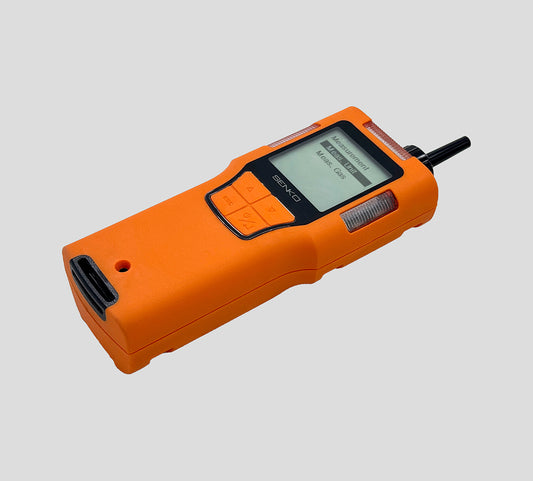
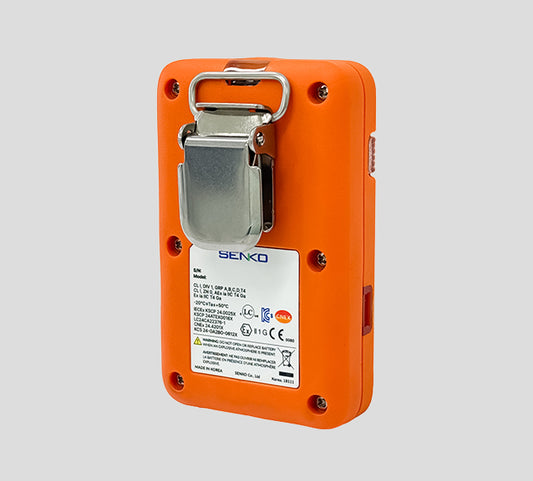
The usual arrangement is one pumped instrument per crew for the pre entry test, and a diffusion monitor on each entrant for the duration. The SP-MGTP is the pumped instrument. The MGT is the worn one.
Single gas or multi gas?
Single gas where the hazard is known, constant and one thing. Multi gas where the atmosphere is unknown or can change.
A single gas personal monitor is the right instrument for a worker at a sour wellsite whose hazard is hydrogen sulfide, or a technician around combustion equipment whose hazard is carbon monoxide. It is small, it is cheap enough to give everybody one, and it does the job it was bought for.
It is the wrong instrument for entering anything. A confined space can hold oxygen deficiency, combustibles and toxics in any combination, and a single gas monitor is silent about the other two. That is a four channel job at minimum.
The SGT is the sealed two year single gas monitor and the SGT-P is the serviceable version with a replaceable sensor and battery.
What does a standard four gas monitor miss?
Carbon dioxide and most solvent vapor. Both are common, and both are invisible to the standard four channels.
The standard four are oxygen, combustibles as percent LEL, hydrogen sulfide and carbon monoxide. That combination covers most confined space fatalities and it is the right default. It also has two well known blind spots.
Carbon dioxide is not combustible, so the LEL channel reads nothing, and because CO2 displaces air physically rather than consuming oxygen, the oxygen channel does not drop below 19.5 percent until carbon dioxide is above about 67,000 ppm. The permissible exposure limit is 5,000 ppm under 29 CFR 1910.1000 Table Z-1. The oxygen sensor is a very late alarm for this gas. If carbon dioxide is credible, add an infrared CO2 channel or carry the iGas CO2.
Solvent vapor is the other. An LEL sensor is built around the fire hazard and resolves in percent of the lower explosive limit, which for most solvents is thousands of ppm. An atmosphere well over a solvent exposure limit can read one percent LEL. That is what a photoionization detector is for, and it is covered under VOC monitoring and PID detectors.
How should alarm setpoints be configured?
To the exposure limits that apply where the crew is standing, which in California are roughly half the federal numbers for the two gases that matter most.
Federally, carbon monoxide is 50 ppm as an eight hour time weighted average under 29 CFR 1910.1000 Table Z-1, and hydrogen sulfide has a 20 ppm ceiling with a 50 ppm peak for a single ten minute period. In California, 8 CCR 5155 Table AC-1 sets carbon monoxide at 25 ppm with a 200 ppm ceiling, and hydrogen sulfide at a 10 ppm ceiling with a 15 ppm short term limit.
Oxygen alarms low at 19.5 percent and high at 23.5 percent, which are the figures 29 CFR 1910.146(b) uses to define deficient and enriched.
Combustible gas is conventionally alarmed at 10 percent of the lower explosive limit, a factor of ten below the concentration at which the atmosphere would burn.
Instruments do not arrive configured for California. If your crews work there, the alarms need setting before the instruments go out.
How often does a portable monitor need bump testing and calibration?
A bump test is a functional check: apply gas, confirm the instrument responds and alarms. A calibration is an adjustment against a known concentration. They are not the same thing and one does not replace the other.
The practice this industry converged on, and what instrument manufacturers generally specify, is a bump test before each day of use and a full calibration on a defined interval. Follow the interval in the manual for the instrument you own, because that is the document an inspector will ask for and the one your warranty depends on.
The underlying reason is that sensors fail quietly. An electrochemical cell at the end of its life, a catalytic bead poisoned by silicone, or a blocked sensor filter all produce a clean, confident, wrong reading. Nothing about the display tells you. Applying gas is the only way to know the instrument still works, and a docking station makes it a thirty second step with a record attached rather than a task somebody skips.
Which application pages should I read?
Confined space entry, for the testing order, the pre entry requirement and the difference between the general industry and construction standards. H2S in oil and gas, for the ceiling limit and why smell is not a warning device.
VOC monitoring and PID detectors, for what a photoionization detector sees, what it does not, and why a total VOC reading is not a benzene measurement. Wastewater, sewers and utility vaults, for why a sewer needs continuous monitoring rather than a single pre entry test.
Primary sources
M Squared Safety Solutions, Inc., 981 Calle Negocio Suite 200, San Clemente, CA 92673, 949-954-6581. Every code and regulatory statement on this page was read against the cited source on 18 September 2026. Model code section numbers are cited to the 2018 International Fire Code and International Mechanical Code. Jurisdictions adopt and amend these codes separately, so confirm the edition in force where the work is. This page describes what the regulations say. Whether a given provision is satisfied at a particular facility is a determination for that employer and the code official.