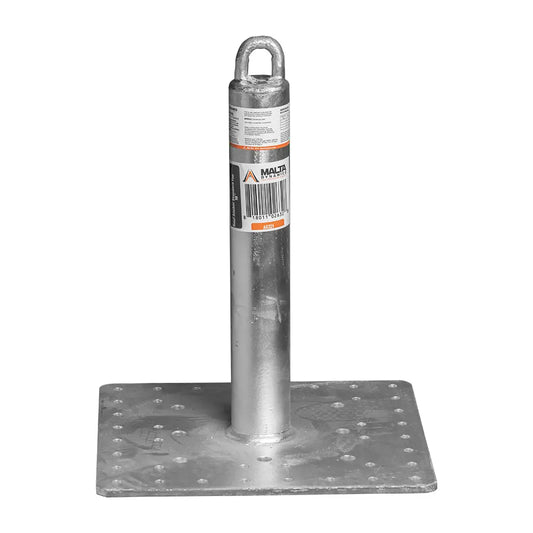
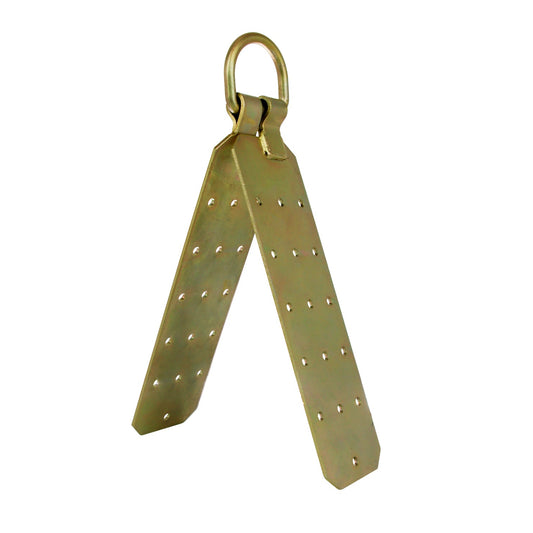
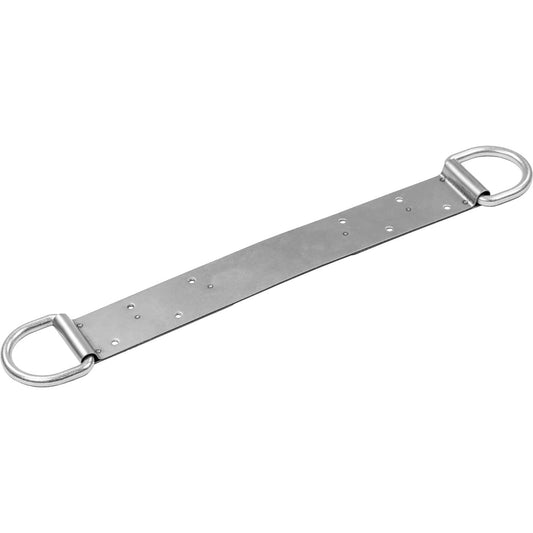
Roof anchors and rooftop tie-off points for roofing and solar crews across the U.S. and Canada. M Squared Safety carries reusable and single-use roof anchors, standing-seam anchors, ridge and peak straps, and permanent anchor plates from Malta Dynamics and Palmer Safety, all meeting ANSI Z359 and OSHA anchorage requirements. Ships nationwide. Not sure which anchor suits your roof? Call 949-954-6581.
The 5,000 pound per employee anchorage requirement in 1910.140(c)(13) and 1926.502(d)(15), and the building owner duty under 1910.27(b)(1) to have anchorages certified, inspected annually and recertified at least every 10 years, are worked through in roof anchors: the 5,000 pound rule and the 10 year recertification.
What is a non-penetrating roof anchor?
A non-penetrating roof anchor is an anchorage connector that creates a fall protection tie-off point without drilling, screwing or welding through the roof deck. It holds position by ballast weight, by clamping to a standing seam, or by gripping a parapet or structural edge, leaving the membrane intact.
The reason crews ask for one is almost never the anchor. It is the roof. On a building under an active single-ply warranty, a bolted anchor means a new penetration, an approved flashing detail and, in most cases, written sign-off from the roofing manufacturer before anyone cuts the membrane. A non-penetrating anchor removes that conversation entirely. What it does not remove is the strength requirement: the anchorage rules below apply the same way whether the anchor is bolted down or ballasted.
The three approaches that follow are the ones that actually get specified. We carry equipment in each of them. Where we do not, this page says so.
Counterweight and Deadweight Systems
A counterweight system is a freestanding rooftop anchor held in place by its own ballast, using mass and friction rather than fasteners to resist fall arrest forces on a flat or low-slope deck.
This is the category that covers most commercial low-slope work: TPO, EPDM and PVC single-ply roofs, ballasted assemblies, and concrete decks where nothing structural is in reach. The unit is wheeled or hoisted into position, the deck takes the load through the base, and nothing touches the membrane except the bearing surface.
The Tie Down 61010 Squatch non-penetrating mobile fall protection system is a rental unit on our rental fleet; it is not offered for sale. Tie Down gives it a gross weight of 1,200 pounds, rates it for use on concrete, TPO and EPDM, and states compliance with OSHA 1926.502 and ANSI/ASSE Z359.6-2009(D). Paired with a horizontal lifeline it extends leading edge coverage across the deck rather than fixing one worker to one point. If you would rather buy a non-penetrating anchor, the Malta Dynamics Standing Seam Roof Anchor is the representative unit we sell for standing seam metal roofs. For counterweighted mast and davit units that reach over a parapet or down a shaft, see the Malta Dynamics XSERIES mobile fall protection range and the wider mobile fall protection systems.
Two things decide whether ballast is the right answer. First, slope. OSHA defines a low-slope roof at 29 CFR 1926.500(b) as a slope less than or equal to 4 in 12, vertical to horizontal, roughly 18 degrees, and anything steeper is a steep roof. Counterweight systems belong on the flat and low-slope side of that line, and the specific maximum for any unit comes from its manufacturer, not from OSHA. Second, whether the deck can carry the point load. A 1,200 pound unit concentrated on a small footprint is a structural question on an older or lightweight deck, and that is a question for the structural engineer of record, not for the crew on the day.
Standing Seam Clamps
A standing seam clamp is a non-penetrating anchor that bolts onto the raised vertical seam of a metal roof panel, transferring load into the seam and the panel clips without piercing the weather surface.
On a standing seam metal roof the seam is the structure you already have, which is why clamping beats ballast here. There is no membrane to protect and no flashing to detail, so the clamp goes on, the work happens, and the clamp comes off leaving the panel unpierced. This is the standard approach on metal roof retrofits, solar racking on metal, and any panel still inside its finish or weathertightness warranty.
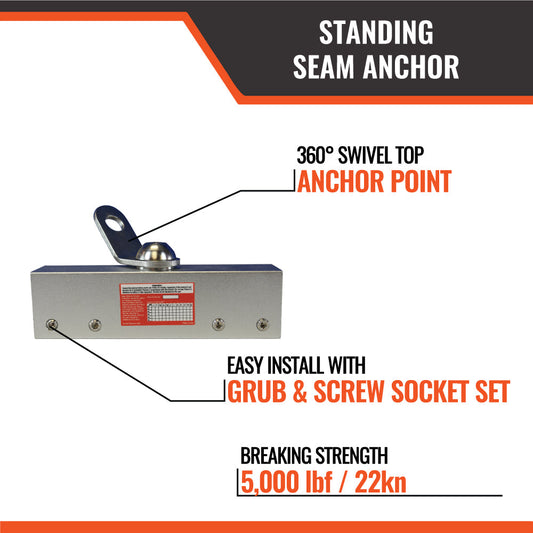
We sell the Malta Dynamics standing seam roof anchor and the Palmer Safety 2-way standing seam anchor. The constraint to respect is fit. Seam profiles are not interchangeable between panel manufacturers, and a clamp sized for one seam geometry is not an anchorage on another. Confirm the profile before the clamp is trusted with a person on it.
G-Clamp and Eave Grappling Systems
A G-clamp or eave grappling anchor is a non-penetrating device that mechanically grips a parapet wall, a structural beam flange or a roof eave, generating its holding capacity through clamping force instead of fasteners.
These solve the case where there is a hard edge to grab but no deck worth ballasting and no seam to clamp. A parapet clamp is the common commercial version: it slides over the parapet, the adjustable arm closes onto the wall, and set screws snug it in place. The Malta Dynamics parapet anchor is the unit we sell in this category, adjustable for parapet walls from 2.36 inches up to 14.1 inches thick, reusable, and installed without cutting the wall or the roof.
Being straight about the rest of this category: we do not sell residential eave grappling hooks or gutter-edge grabbing anchors. On residential and low-rise eave work our range is the fastened roof anchors and peak straps listed on this page, and where passive protection is feasible it is the better control anyway, so see guardrail systems. For beam flange clamps, concrete anchors, D-ring plates and cross-arm straps that are not roof-specific, see fall protection anchors and anchorage connectors.
Non-penetrating roof anchor specification comparison
| System type |
How it resists load |
Suited to |
Roof slope |
Membrane and warranty impact |
Main constraint |
| Counterweight / deadweight |
Ballast mass and friction against the deck |
Flat and low-slope commercial decks; concrete, TPO, EPDM |
Low-slope only, at or below 4 in 12 per 1926.500(b); manufacturer sets the unit maximum |
No penetration; membrane and warranty untouched |
Deck must carry the point load; Squatch gross weight is 1,200 lb |
| Standing seam clamp |
Clamping force on the raised vertical seam |
Standing seam metal roofs only |
Follows the panel; not limited to low-slope |
No penetration; panel finish warranty untouched |
Clamp must match the exact seam profile |
| Parapet / edge clamp |
Clamping force on the parapet wall or beam flange |
Flat roofs with a parapet; steel edges |
Not slope-dependent; depends on the edge |
No penetration of roof or wall |
Wall thickness must be in range; Malta Dynamics parapet anchor covers 2.36 in to 14.1 in |
| Fastened roof anchor (for contrast) |
Bolts, screws or welds into the structural deck |
Permanent tie-off points on buildings you control |
Low-slope and steep, per the anchor |
Creates a penetration; needs an approved flashing detail and, usually, roofing manufacturer sign-off |
Carries the annual inspection and 10-year recertification duty under 1910.27(b)(1) |
The strength requirement is identical down every column. Under 29 CFR 1926.502(d)(15) an anchorage used for attachment of personal fall arrest equipment must be independent of any anchorage supporting or suspending platforms and capable of supporting at least 5,000 pounds per employee attached, or designed, installed and used as part of a complete personal fall arrest system maintaining a safety factor of at least two, under the supervision of a qualified person. In general industry 29 CFR 1910.140(c)(13) states the same 5,000 pounds for each employee attached, with the same safety factor of two alternative. Anchorage connectors themselves are manufactured and tested to ANSI/ASSE Z359.18-2017, the anchorage connector standard within the ANSI Z359 fall protection code, and complete active systems are designed under ANSI/ASSE Z359.6.
Not sure which of the three fits your deck? Call 949-954-6581 and describe the roof.
Non-penetrating roof anchor FAQ
Does a non-penetrating roof anchor still have to hold 5,000 pounds?
The anchorage strength requirement does not change with the mounting method. For construction work, 29 CFR 1926.502(d)(15) requires anchorages used for attachment of personal fall arrest equipment to be capable of supporting at least 5,000 pounds per employee attached, or to be designed, installed and used as part of a complete personal fall arrest system that maintains a safety factor of at least two, under the supervision of a qualified person. For general industry, 29 CFR 1910.140(c)(13) sets the same 5,000 pound figure per employee attached and the same safety factor of two alternative.
Will a non-penetrating anchor void a roof warranty?
It is the penetration, not the anchor, that creates the warranty problem. A single-ply membrane warranty is written around an intact membrane and an approved flashing detail at every penetration. Cutting the membrane to bolt or weld an anchor into the deck adds a penetration the roofing manufacturer did not detail, and manufacturers generally require their written approval before new penetrations are made. A ballasted or clamped anchor sits on the assembly instead of through it, which is why it is the usual answer on a roof still under warranty. Confirm the terms with the roofing manufacturer before work starts.
What roof slope can a counterweight anchor be used on?
OSHA defines a low-slope roof at 29 CFR 1926.500(b) as a roof having a slope less than or equal to 4 in 12, vertical to horizontal, which is about 18 degrees. Above that it is a steep roof. Counterweight and deadweight systems are built for flat and low-slope decks, because they resist load through mass and friction. The maximum slope for any specific unit is set by its manufacturer rather than by OSHA, so check the manual for the model you are using.
Do standing seam clamps damage the metal panel?
A standing seam clamp attaches to the raised vertical seam rather than through the panel, so the weather surface is not pierced and no flashing is needed. Some designs use set screws that bear directly on the seam. Seam geometry varies between panel manufacturers, so confirm the clamp is approved for your specific panel profile and seam type before it is used as an anchorage.