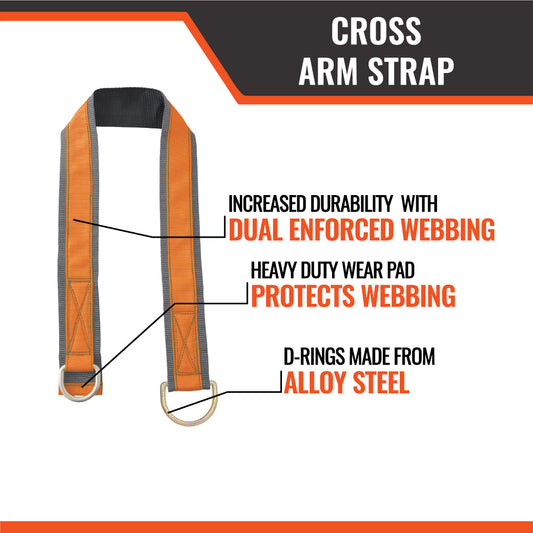
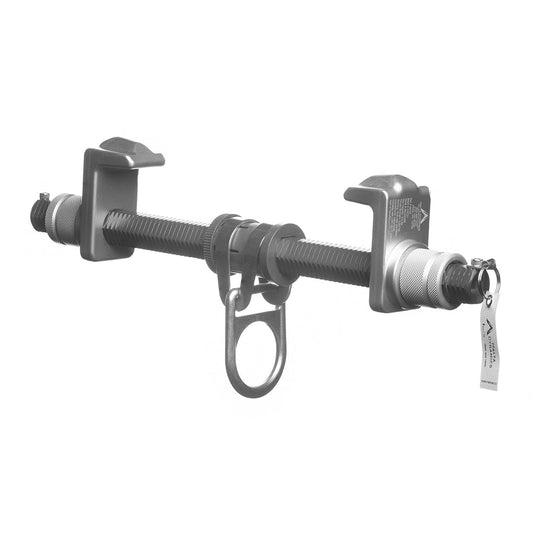
Fall protection anchors and anchorage connectors for steel, concrete and general industry work across the U.S. and Canada. M Squared Safety carries beam anchors, concrete anchors, cross-arm straps, D-ring plates, and reusable and permanent tie-off points from Malta Dynamics and Palmer Safety, engineered to meet ANSI Z359 and OSHA fall-arrest requirements. Not sure which anchor fits your project? Call 949-954-6581.
Working on a roof? The roof-specific range, including non-penetrating options for membrane and metal decks, sits on roof anchors and non-penetrating rooftop tie-off points. This page covers everything that is not roof-specific.
The certification rule almost nobody has been told about
If a permanent roof anchor is used with a rope descent system, which covers most window cleaning, facade work and suspended maintenance, there is a written obligation sitting on the building owner and it is routinely missed.
Under 29 CFR 1910.27(b)(1), before any rope descent system is used the building owner must inform the employer in writing that the owner has identified, tested, certified and maintained each anchorage so it is capable of supporting at least 5,000 pounds in any direction for each employee attached. That certification has to rest on an annual inspection by a qualified person, with certification of each anchorage by a qualified person as necessary and at least every 10 years. It had to be implemented no later than 20 November 2017.
Two things follow. A building relying on anchors installed years ago and never re-certified is already out of compliance. And a contractor cannot self-certify somebody else's anchors, so the contractor who accepts a verbal assurance is the one carrying the exposure.
The 5,000 pound per employee anchorage requirement in 1910.140(c)(13) and 1926.502(d)(15), and the building owner duty under 1910.27(b)(1) to have anchorages certified, inspected annually and recertified at least every 10 years, are worked through in roof anchors: the 5,000 pound rule and the 10 year recertification.
Choosing an anchor
-
Permanent or temporary. Permanent anchors suit points used repeatedly on a building you control, and only where somebody will own the annual inspection and the 10-year re-certification. That ownership is the part that gets skipped, and an uncertified anchor is worse than no anchor because people trust it.
-
What you are anchoring to. Steel, concrete, wood truss and standing-seam metal all take different hardware. Guessing here is how anchors get installed into something that will not hold the load.
-
Reusable or single-use. Single-use roof anchors are cheap and get left behind; reusable anchors cost more and travel.
-
Where there is nothing to anchor to. On big-box, tilt-up and newly re-roofed buildings there is frequently nothing structural in reach. Then you either bring the anchorage with you or remove the need for one. See mobile fall protection systems and guardrail systems.
Anchorage FAQ
How strong does a roof anchor have to be?
At least 5,000 pounds per attached employee, or a system designed, installed and used under the supervision of a qualified person maintaining a safety factor of at least two. General industry: 29 CFR 1910.140(c)(13). Construction: 29 CFR 1926.502(d)(15). For rope descent specifically, 1910.27(b)(1) adds that the 5,000 pounds must hold in any direction.
Do permanent roof anchors have to be certified?
Yes, where they are used with a rope descent system. Under 29 CFR 1910.27(b)(1) the building owner must inform the employer in writing that each anchorage has been identified, tested, certified and maintained to support at least 5,000 pounds in any direction per employee attached, based on an annual inspection by a qualified person and certification at least every 10 years. The requirement had to be implemented no later than 20 November 2017.
Is there a height limit on rope descent systems?
Yes. Under 29 CFR 1910.27(b), no rope descent system may be used for heights greater than 300 feet above grade unless the employer demonstrates that it is not feasible to access those heights by any other means, or that the alternatives pose a greater hazard.
What do we do on a roof with no anchor at all?
Bring the anchorage with you or remove the need for one. A mobile fall protection system is a freestanding relocatable anchor that travels with the work. Guardrail is the passive alternative and the stronger control where it is feasible, because it protects everyone on the deck without a training-dependent step.
Can we rent anchors and mobile anchor systems?
Anchors themselves are sold rather than rented. Mobile anchor systems, guardrail and confined space equipment are on the rental fleet, nationwide across the U.S. and Canada. See the rental rate sheet.
Does an anchor need inspecting before each use?
Yes. Personal fall arrest components are inspected before each use for wear, damage and deterioration, and defective components are removed from service. That is separate from, and does not replace, the building owner's annual and 10-year certification obligation for rope descent anchorages.