Roof hatch guardrail and hatch railing kits for buildings and facilities across the U.S. and Canada. Complete Tie Down kits with the self-closing gate included, sized to the hatch. Sale and rental, ships nationwide. Call 949-954-6581.
A roof hatch is a hole in a walking surface
OSHA treats it as one, and it is one of the few places on a roof where a worker can step backwards into an opening while carrying something and never see it coming. The hatch lid is not the control. A propped-open lid is not a cover.
What OSHA actually requires at a roof hatch
In general industry, each employee has to be protected from falling through any hole 4 feet or more above a lower level, using covers, guardrail systems, travel restraint or personal fall arrest, per 29 CFR 1910.28(b)(3). In construction the trigger height is 6 feet, under 29 CFR 1926.501(b)(4) for holes.
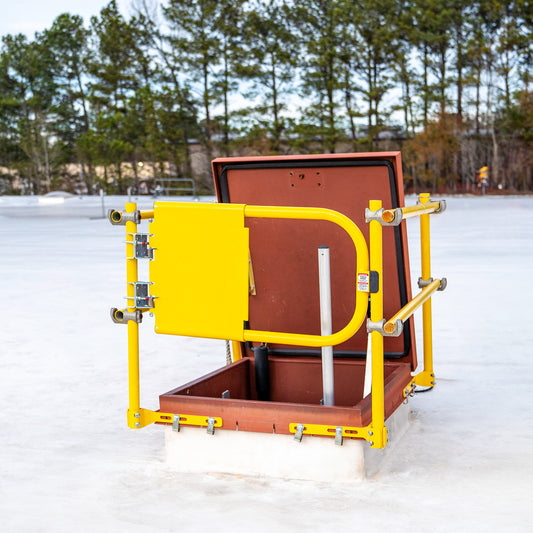
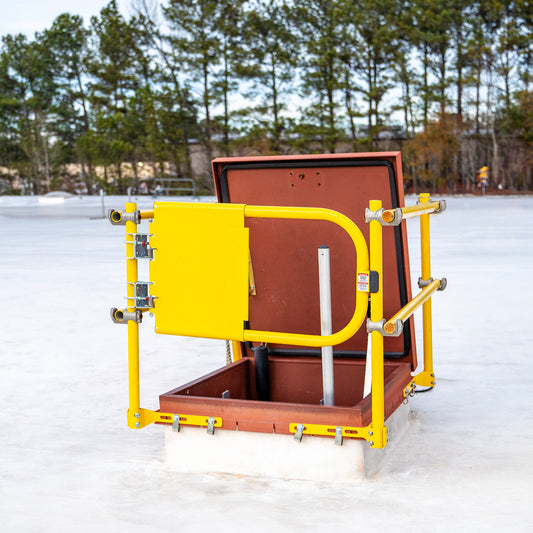
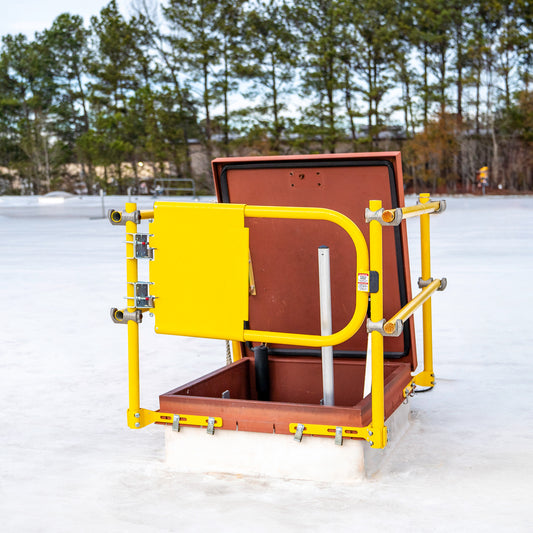
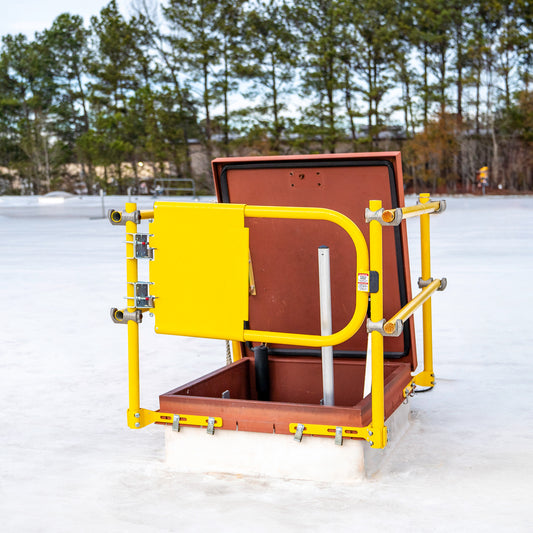
Where a guardrail system is used around a hole that serves as a point of access, such as a ladderway, 29 CFR 1910.29(b)(13) requires the guardrail opening to either have a self-closing gate that slides or swings away from the hole, fitted with a top rail and midrail, or be offset so a person cannot walk directly into the hole. That is the detail most hatch installations get wrong: three sides railed, the fourth left open at the ladder.
Rail geometry is the same as anywhere else. The top rail sits at 42 inches, plus or minus 3 inches, above the walking surface under 29 CFR 1910.29(b)(1), and must hold 200 pounds of applied force without dropping below 39 inches. California employers sit under Cal/OSHA as well; roof and floor openings are covered by 8 CCR 3212, Floor Openings, Floor Holes, Skylights and Roofs.
The self-closing gate is the part people skip
A chain across the ladder opening is not a self-closing gate. Neither is a removable rail section that gets left leaning against the parapet. The standard asks for a gate that closes on its own, because the failure mode it is written against is a worker climbing out of the hatch with both hands full and no way to re-close the opening behind them. Every complete kit below ships with the gate.
The alternative the standard allows is an offset: build the railing so the path out of the hatch turns before it reaches open floor. Where the roof layout permits it, an offset is the more durable answer, because there is no mechanism to maintain and nothing to prop open.
Non-penetrating on a membrane roof
Most hatches sit on a curb in the middle of a TPO, EPDM or modified bitumen field, and drilling that field to bolt down a railing is how you lose a roof warranty. These kits mount to the hatch curb rather than the membrane, so the roof stays watertight and the warranty stays intact.
Sizing a kit to your hatch
-
30 in. x 36 in. hatch. Tie Down 71038 complete kit, gate included.
-
48 in. x 48 in. hatch. Tie Down 71089 complete kit, gate included.
-
54 in. x 30 in. hatch. Tie Down 71095 complete kit.
-
96 in. x 30 in. hatch. Tie Down 71084 railing.
-
Universal. Tie Down 73057 Hatch Mate, a universal roof access hatch system where the opening does not match a standard kit.
To specify one we need the hatch opening dimensions, the curb height, which side the ladder comes up, the roof membrane type, and whether anything on the roof restricts the offset path. Call 949-954-6581 and describe the roof.
Where a hatch railing is not enough on its own
Guardrail at the hatch protects the hatch. It does nothing about the rest of the trip. If the crew then works near an unprotected roof edge, or around a skylight, you still need perimeter guardrail or a personal fall arrest system, and on a roof with no structural anchor point that usually means a mobile fall protection system providing an overhead anchor without penetrating the deck. Passive protection where it fits, personal systems where it does not.
Roof hatch guardrail FAQ
Does OSHA require a guardrail around a roof hatch?
A roof hatch is a hole in a walking-working surface. In general industry, 29 CFR 1910.28(b)(3) requires employees to be protected from falling through any hole 4 feet or more above a lower level by covers, guardrail systems, travel restraint or personal fall arrest. A guardrail system is the usual answer at a hatch, because the opening has to stay usable.
How tall does a roof hatch guardrail have to be?
The top rail must be 42 inches, plus or minus 3 inches, above the walking surface under 29 CFR 1910.29(b)(1), and must withstand at least 200 pounds of applied force without deflecting below 39 inches.
Does a roof hatch railing need a self-closing gate?
Yes, unless the railing is offset. Under 29 CFR 1910.29(b)(13), a guardrail opening at a point of access such as a ladderway must have a self-closing gate that slides or swings away from the hole, with a top rail and midrail, or be offset so a person cannot walk directly into the hole. A chain or a removable rail section does not meet it.
Can a roof hatch guardrail be installed without penetrating the roof?
Yes. These kits mount to the hatch curb rather than through the membrane, which protects a TPO, EPDM or modified bitumen roof and any warranty on it.
What size hatch railing do I need?
Match the kit to the hatch opening. We stock complete kits for 30 x 36, 48 x 48, 54 x 30 and 96 x 30 openings, plus a universal Hatch Mate system for openings that do not match a standard kit.
Can I rent a roof hatch guardrail?
Yes. Guardrail systems are available for sale or rental nationwide across the U.S. and Canada. Call 949-954-6581 with the hatch dimensions and roof type for availability.
Is the hatch lid enough on its own?
Only while it is closed and only if it meets the cover requirements. A propped-open lid is not a cover and does not protect the opening, which is exactly when workers are moving through it.